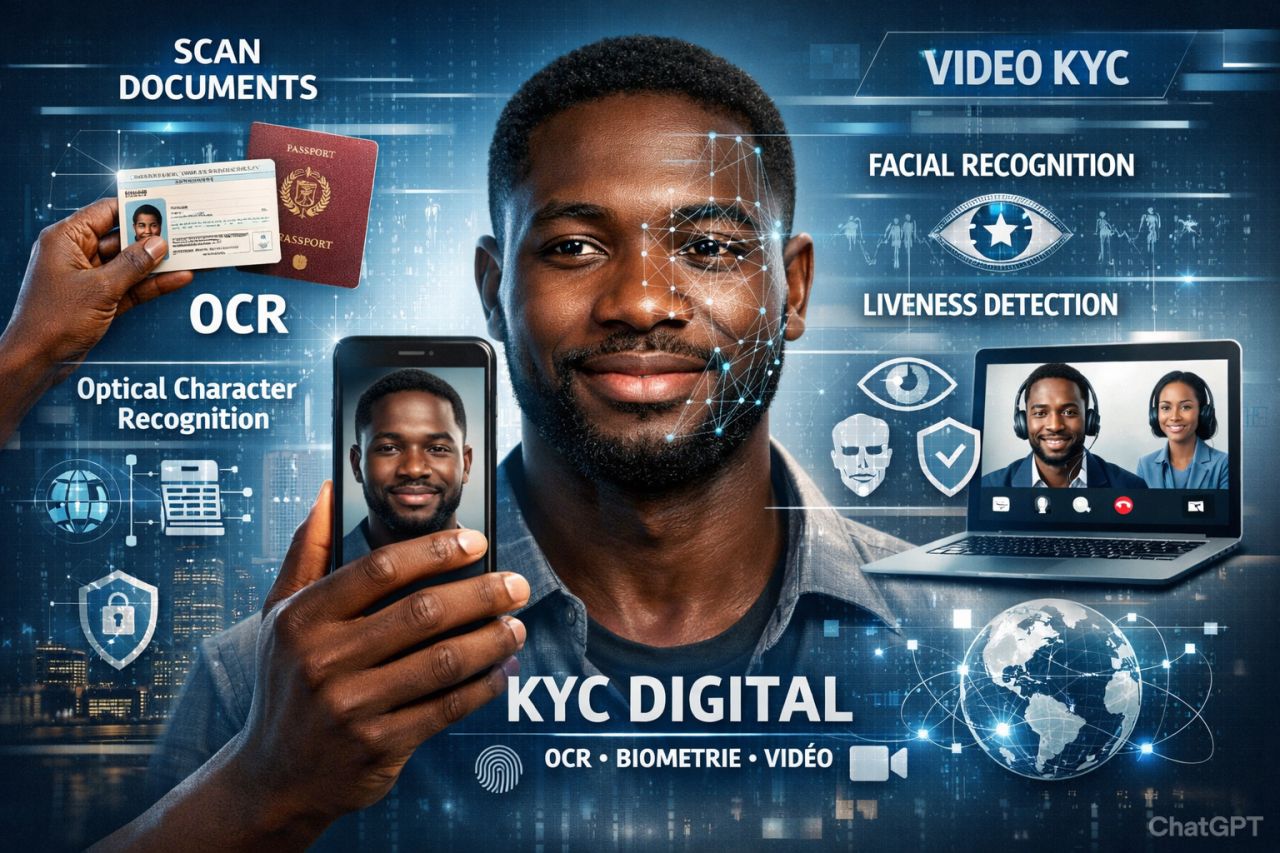
DIGITAL KYC
Trust is a bank's true capital. To establish it, there is a golden rule: Know Your Customer. With rising fraud and regulatory requirements against money laundering and terrorist financing, knowing customers is a strategic imperative.
How can stronger security be combined with a smooth customer experience? Digital KYC offers an answer.
How does it work?
It is paperless identity verification, performed in minutes from a smartphone or computer:
1. Submission: the customer sends a photo of an identity document.
2. Document verification: OCR, Optical Character Recognition, extracts information and checks document authenticity.
3. Biometric verification: facial recognition compares a selfie or short video with the document photo.
4. Liveness detection: the user smiles or blinks to demonstrate that they are a real person rather than a photograph or mask.
5. Decision: data are checked against watchlists and KYC is approved.
Key technologies
Besides OCR, biometrics, liveness detection and video, two technologies are changing the picture:
• AI and machine learning analyse data in real time to detect anomalies and sophisticated fraud such as deepfakes.
• Blockchain promises decentralised management where users control their personal data.
Benefits and challenges
Digital KYC is a revolution with two sides.
Benefits:
• For banks: lower costs, stronger compliance and operational efficiency.
• For customers: fast, more secure onboarding available 24/7.
Challenges:
• New threats: deepfakes test detection systems.
• False positives: some users risk exclusion because of poor lighting or particular features.
• Data protection, technological dependence and regulatory complexity, especially in CEMAC.
Digital KYC is a strategic tool placing speed and security at the heart of digital trust.
How do you see identity verification evolving in your sector? If you enjoyed this post, a share or like would help. Stay connected for more digital topics.
#KYC #DigitalBanking #Fintech #Sécurité #AML #ExpérienceClient #Innovation #BanqueDigitale