⚙️ How money works
We continue our series about money.
Money is about trust
Money rests on users' collective trust. In our CA7 bar, an invisible agreement between customers and the owner allows credit vouchers to be exchanged for food and drinks.
Exclusive authority
Under that agreement, only the bar may issue vouchers. If Bokhit creates his own, he could bankrupt it by consuming without paying, or paying with counterfeit vouchers. If the country is this large bar, the state must ensure exclusive note issuance. If everyone prints money, oversupply reduces its value. Monetary creation must therefore be strictly controlled through the central bank.
Somewhere in Gondwana, however, a third party rather than the state prints the notes. Imagine that printer playing a trick on us one day—but that is another story.
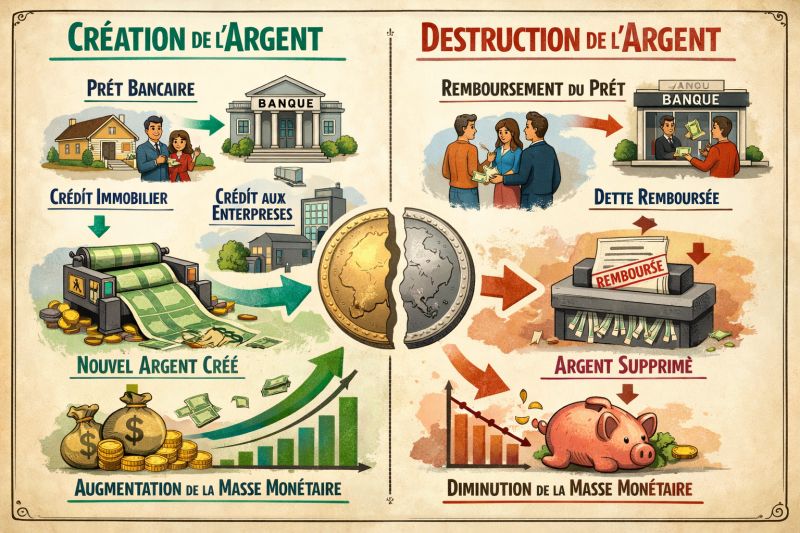
Creation and destruction
Simply put, money is created through debt, such as your home loan, and destroyed through repayment—you certainly worked hard for it! 😂
Supply and demand
Scarcity makes things expensive. If a product is scarce and many want it, its price rises; abundance with little demand lowers the price.
The same applies to notes. Too many relative to goods or wealth produced reduces their value. Bread might cost CFA 1,000, but we do not complain because we easily found 20 million. This is inflation: purchasing power falls because we pay more for the same goods. I miss the CFA 25 mandawa, roasted peanuts, that satisfied my hunger as a child.
Two other concepts matter: interest and speculation.
• Interest: renting your money to someone and expecting repayment with a profit. A bank loan repaid over time carries interest, the price of time.
• Speculation: buying cheaply to sell at a higher price later, a bet on future profit. Millet-market traders regularly store food to sell at higher prices during the lean season.
This is a balancing act involving consumers, markets and banks. We will discuss them in the next post.