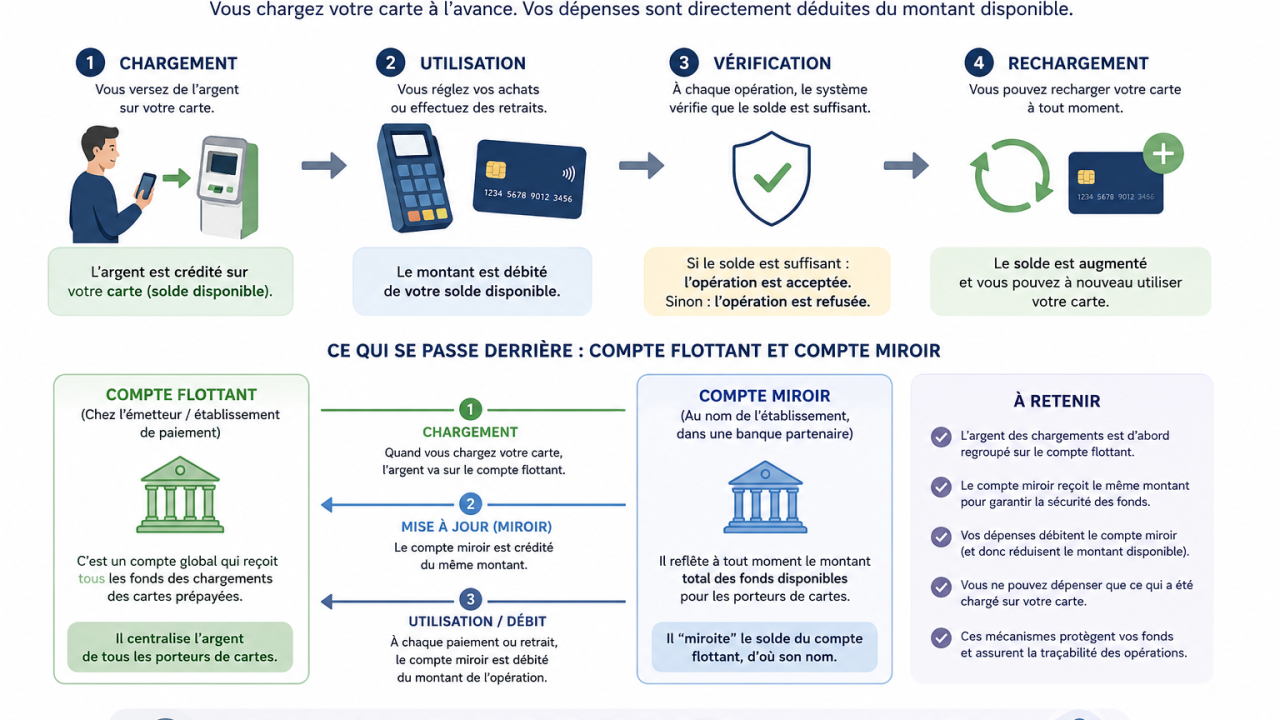
Prepaid cards have become very common in African banks, and our fintechs are joining in. It is worth taking a moment to understand how they work. Where is my money actually held: on the card itself, or somewhere else?
Participants in a prepaid-card programme
A programme generally involves three or four participants: a bank, processor, network, and sometimes a fintech or Mobile Money operator under BIN sponsorship.
• Bank: issues the card and owns the BIN allocated by the network, such as Visa or Mastercard. It sells the cards to its customers.
• Processor: acts between the bank and network and handles transaction processing.
• Network: routes the transaction to the acquiring bank.
• Fintech/Mobile Money: usually present only in a sponsored programme, because regulators, at least in CFA franc zones, do not allow them to issue cards directly.
2. How transactions work
Level 1: the float account
Suppose 10,000 customers each hold a prepaid card with a balance. Their combined balances total XAF 500 million. This money is deposited in a specific bank account called a float account. This is where the prepaid-card funds are actually held.
Level 2: the processor's mirror account
As the intermediary between the bank and network, the processor must respond within milliseconds when a transaction arrives. It therefore maintains a database with each customer's details. For simplicity, assume it keeps two essential items per customer: the card identifier and the balance at a given time.
This database is often called a mirror account: an electronic representation of customer balances.
It reduces response times because the network does not access core banking for authorisation requests. The processor keeps essential information current: balances, limits, blocks and authorisations.
3. A practical example
Loading a card
Maimouna, a new customer, loads XAF 100,000 onto her card. What happens behind the scenes?
At the bank
The float account already contains XAF 500 million from existing customers. It is credited with XAF 100,000, bringing it to XAF 500.1 million. The money is genuinely deposited: Maimouna paid it into the bank to load her card.
At the processor
A new entry is added to the mirror account. Its initial balance is zero when the card is issued to Maimouna, then XAF 100,000 is credited to reflect the top-up.
Making a purchase
Suppose she buys something for XAF 20,000, such as a Canal Plus TV subscription top-up.
The network, for example Visa, sends an authorisation request to the processor: valid card, sufficient balance, valid PIN and transaction limits. The processor approves the payment and debits the card balance to XAF 80,000: 100,000 − 20,000.
The bank makes an actual XAF 20,000 debit from the float account, which falls from XAF 500.1 million to XAF 500.08 million.
The XAF 20,000 reaches the beneficiary, Canal Plus, through settlement mechanisms.
4. A simple analogy
Imagine arriving at a hotel. Reception offers to keep your valuables—jewellery and watches—in its safe.
• Hotel safe = float account, holding the real money.
• Reception's computer register = processor's mirror account.
• Room key card = prepaid card.
The card does not contain your money. The register is not the money either. The money is in the safe. The card simply proves that you are entitled to part of it.
5. Closing thoughts
In most African prepaid-card programmes operated with processors:
• Real money is held in a float or ring-fenced account with the issuing bank.
• The processor maintains a mirror ledger for real-time authorisations.
• The card does not hold the money; it holds identifying data that allows access to the balance.
• Total ledger balances must continuously match the funds in the float account, allowing for transactions undergoing clearing and settlement.
We have reached the end of this article. I hope it helped. A like or share would be welcome. If you are interested in banking, card payments, Mobile Money or fintech, this page is yours: a place to explain and demystify banking concepts.
#banques, #monétique, #mobileMoney, #fintech