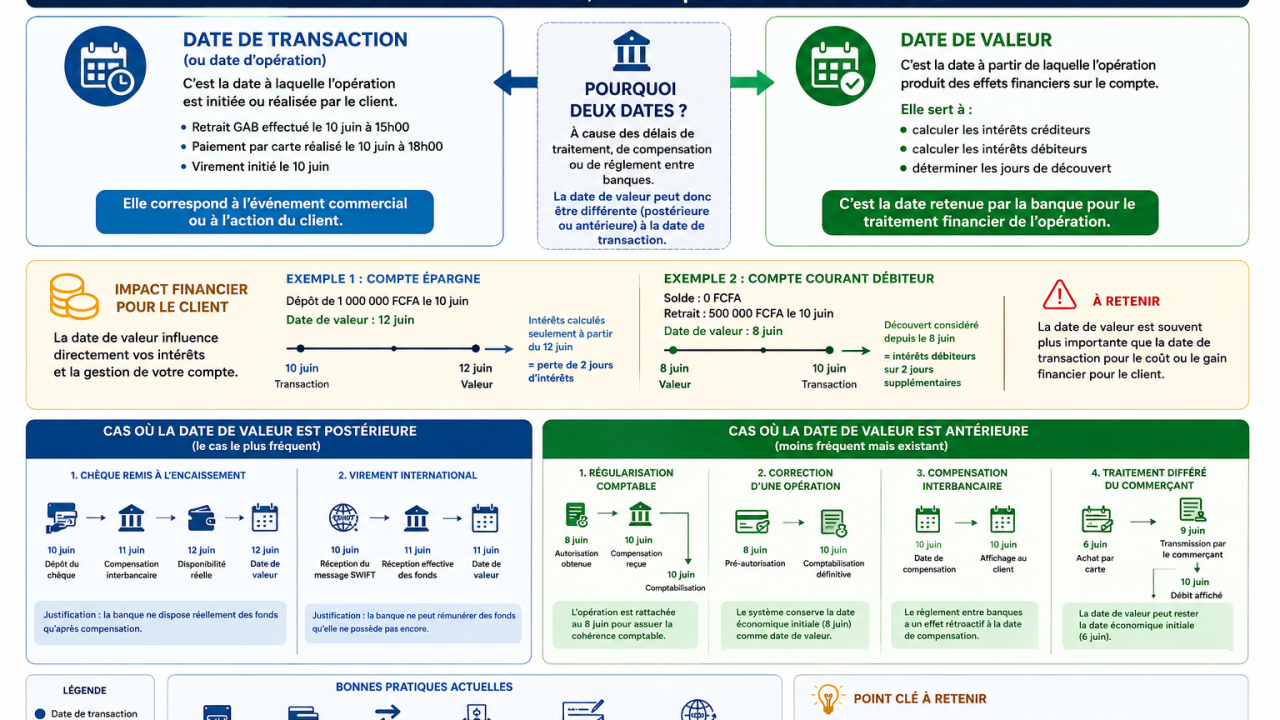
The value date and transaction date are two distinct concepts that are important to understand in banking. Knowing the difference can sometimes help you optimise your bank charges.
1. Definitions
Transaction date, or operation date
This is the date on which a customer initiates or carries out a transaction. If I withdraw cash from an ATM today, Saturday, at 15:00, today is my transaction date. It records when the business event or customer action took place.
Value date
This is the date from which a transaction affects interest calculations and the account's cash position. In other words, it is the date on which the bank considers the transaction to truly count towards your account.
2. Historical origins of value dates
Several factors explain their origins: physical cheque processing, time-consuming interbank clearing and manual transaction processing.
A bank might receive a transaction today but not actually have the funds until several days later. Banks introduced value dates to account for this delay.
With banking automation, the scope of value dates should now shrink significantly and remain only for certain cases: regulation, clearing delays, banking risk and international transactions.
3. Observed patterns
Value date after the transaction date
This is most common for credits. It assumes that processing time is needed before your deposit can actually affect your account.
Value date before the transaction date
This is most common for debits. At first glance, it seems illogical—unless, in African mysticism, someone tells me that the soul of my money was stolen days ago and the fateful transaction day merely confirms that destiny! In practice, several explanations are possible: accounting adjustments, correction of a pending transaction, interbank clearing or delayed merchant processing.
4. Financial impact on the customer
The value date is often more important than the transaction date. It can hurt the customer's finances if overlooked. Consider a credit with a T+2 value date. If the account earns interest, interest on that amount starts at T+2, to the bank's delight: you receive two fewer days of interest. Conversely, a debit with a T−2 value date also benefits the bank, which treats the interest-bearing balance as having fallen two days earlier.
5. Is this practice still justified?
In today's payment environment—real-time processing, instant payments and EMV cards—backdated value dates are increasingly challenged by customers who feel disadvantaged.
Current good practices generally suggest that ATM withdrawals, card payments, instant transfers and cash deposits should no longer be affected by value-date delays. Cheques and international transfers may still use value dates to reflect the account balance when funds are actually available or consumed.
6. A practical example
Nothing beats a good example. Suppose your savings account has only two value dates under the bank's terms: the 1st and 15th of each month. Your current balance is XAF 1 million.
On the 2nd, you deposit XAF 9 million in the morning. You consider your balance to be XAF 10 million. An emergency arises, and a few hours later you withdraw XAF 7 million. You believe XAF 3 million remains, which is technically correct.
However, at month-end the bank charges interest on XAF 6 million for the period from the 2nd to the 15th. The reason is simple: your deposit has not yet reached its value date, so the XAF 7 million withdrawn is not yet fully considered yours. The bank has effectively lent you XAF 6 million, in addition to the XAF 1 million you already held. It is subtle, but that is roughly how it works.
7. Closing thoughts
The transaction date describes when a transaction took place; the value date describes when it has a financial effect on interest, overdrafts and available funds.
A later value date is generally linked to clearing or settlement delays. An earlier value date may be technically justified in some cases—card authorisation, clearing or adjustments—but must be consistent, documented and compliant with applicable regulations.
#monétique, #digitalbanking, #mobilemoney, #DateDeValeur, #fintech