Money is a bank's raw material. It therefore takes great care of it, particularly when lending to unfamiliar customers, since KYC is not infallible. A simplistic approach would be to lend only to the wealthy. But concentrating solely on VIP customers would not be viable, especially in countries where industrialisation is still emerging and the economy is strongly linked to the informal sector.
A bank's resources are finite, so it cannot lend to everyone even if it wanted to. It needs an assessment method to determine whether a customer qualifies for credit.
A small analogy
Suppose the government offers scholarships for school graduates to study medicine abroad. Unable to fund everyone, it establishes criteria:
• graduate with at least a good distinction;
• achieve at least 12 in science subjects;
• be no older than 25;
• have no major physical disability;
• and so on.
These filters, chosen by the government, give it some reassurance that it is making a sound investment. Banks do something similar: they want to be confident that borrowers will have the resources to repay them.
2. A scoring model
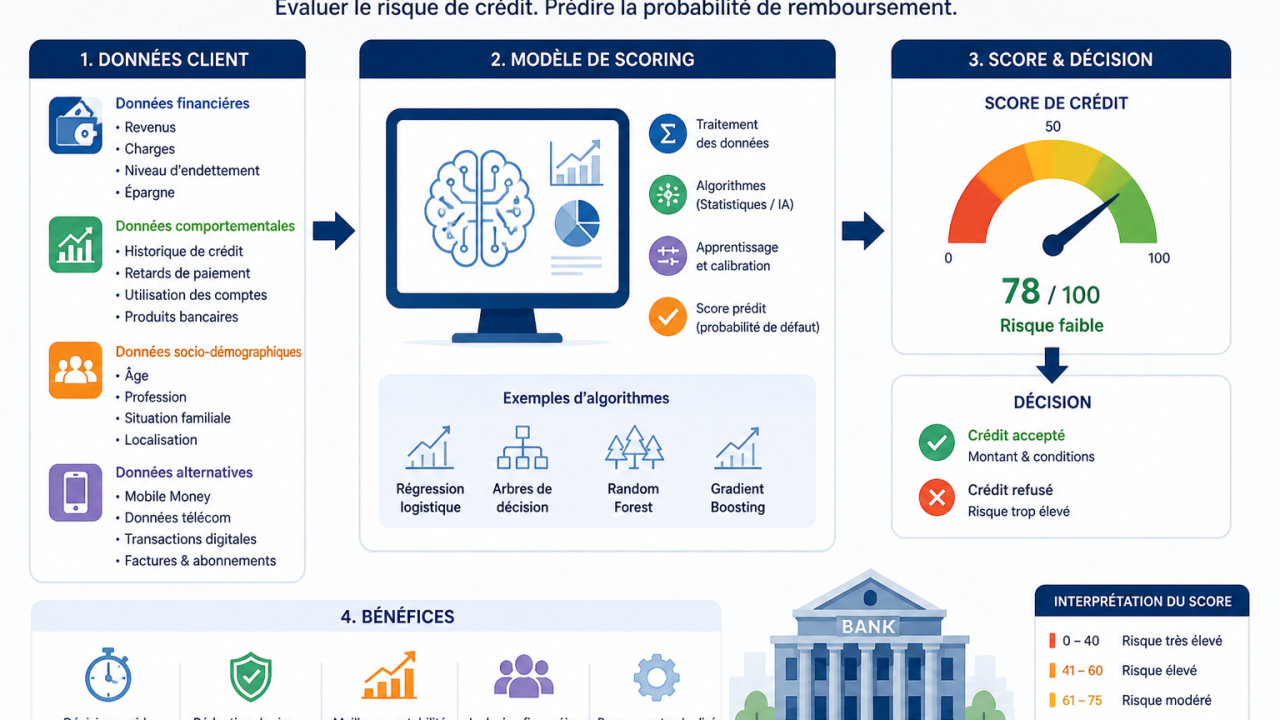
A scoring model assigns customers a score based on financial, behavioural and socioeconomic criteria. The higher the score, the more reliable the customer is considered. The objective is to reduce future default risk and decide quickly whether a customer qualifies for credit.
3. Types of scoring
Different objectives require different scores: application scoring, behavioural scoring or collection scoring. This article briefly covers lending application scoring; specialist credit-risk pages can explore the subject further.
4. Variables used in scoring
Credit scoring uses at least three broad categories.
Financial data: income, expenses, debts and savings help a bank assess the requested credit. This is why a bank B may ask you to redirect your salary from bank A when you apply for a loan: it wants a clearer view.
Behavioural data: repayment history, incidents and product usage help form an opinion. You generally cannot open an account and request a loan on the same day. I am not saying it is impossible, but give the bank time to understand your relationship with money.
Sociodemographic data: examples explain this better than a long speech.
• Age: you cannot request a ten-year loan when retirement is two years away.
• Health: you have an incurable illness and limited time, and now request a large loan. Can that work?
• Profession: your work must be legal, since the bank deals with actors operating within the law. For example, you cannot request credit extending beyond a fixed-term employment contract.
• Family circumstances: you are a confirmed bachelor with no visible ties or investments and ask for tens of millions. It certainly will not be easy.
Alternative data: these criteria are not fixed. Mobile Money, telecom and digital-transaction data can also be used. The essential aim is to lend to the right person.
5. Building a scoring model
Methods include traditional statistics, such as logistic regression and discriminant analysis, and advanced AI or machine-learning methods: decision trees, random forests, gradient boosting and neural networks.
With AI's emergence, banks are moving towards hybrid models combining statistics and artificial intelligence.
6. Limitations and risks
Scoring offers automation, reduced risk and fast, objective decisions. However, its relevance depends heavily on data quality and can be affected by economic changes.
7. Digital lending
When credit analysis can largely be performed through applications, it opens the way to digital lending: loans granted entirely online without visiting a branch.
We will discuss digital lending in a future article.
If you enjoyed this article, a like or share is always appreciated. Please follow this page, which explains digital banking and Mobile Money.
#DigitalBanking, #MobileMoney, #CEMAC, #monétique, #DigitalLending